Document Remediation

Create an inclusive patient experience, build lasting trust, and meet federal and state compliance by making every document accessible to every patient.
A person with Down Syndrome is sitting at a coffee table with a laptop open in front of them, looking down at the screen.

The Overlooked Barrier to Inclusive Patient Care

You’ve worked hard to make your website accessible, but what about the countless patient-facing documents you share daily? From Explanations of Benefits (EOBs) to clinical results, these files are vital extensions of your digital services.

For the one in four adults with a disability, an inaccessible document isn’t just an inconvenience—it’s a barrier to managing their own health. Untagged PDFs are invisible to screen readers, preventing a blind patient from reviewing their lab results or a person with low vision from reading their medication instructions.

This gap not only creates risks to patient safety but also excludes a large part of the community from your services. Federal laws like Section 504 and Section 1557 of the ACA mandate that all digital communications must be accessible, making document remediation an essential part of modern patient care.

Why Accessible Documents Matter

Enhances Patient Safety & Autonomy

When a patient can independently read their own medical instructions, lab results, and consent forms, it directly improves their health outcomes and empowers them to be active participants in their care.

Builds Patient Trust & Loyalty

Offering accessible documents demonstrates a commitment to serving all members of your community, strengthening your reputation and fostering long-term patient loyalty.

Expands Your Patient Base

By removing barriers, you open your doors to a wider audience of patients with disabilities and their families, positioning your organization as a truly inclusive provider.

Ensures Legal Compliance

Proactively making documents accessible protects your organization from rising lawsuits and significant financial penalties for violating federal laws like the ADA, Section 504, and Section 1557.

Ensure Every Patient Can Read, Understand, and Act on Their Health Information
AccessiTREE specializes in the remediation of healthcare documents. We transform your inaccessible files into fully compliant, user-friendly resources that work seamlessly with assistive technologies. We ensure every patient can independently and privately access their most important health information.

We Remediate All Your Critical Healthcare Documents:

Patient Intake & Consent Forms

Digital versions of intake and consent documents — such as new-patient registration forms, medical history questionnaires, HIPAA authorisations, informed-consent agreements, and pre-surgery digital check lists — must conform to WCAG 2.1 AA standards when made available on a website or app (or via electronic submission). Under the HHS/Section 504 update, healthcare providers who receive federal funds must ensure that all web-based or app-based forms are perceivable, operable, understandable, and robust for users with disabilities.

In practice, this means: every form field must have properly associated labels and instructions, error states must be clearly described (for example, “Please enter your date of birth” rather than leaving a blank), keyboard navigation must allow users to move through fields without a mouse, and the form layout must support screen-readers and assistive technologies. As a result, patients with visual, motor, or cognitive impairments can complete their intake independently, avoid delays at check-in, and ensure their consent and medical history are accurately captured.

Explanations of Benefits (EOBs)

Documents such as explanations of benefits, cost-sharing summaries or insurance payment notices that patients receive digitally must meet accessibility standards when posted on a website or in a patient portal. Because these documents often contain dense tables, numeric data, and payment-flow logic, ensuring accessibility is especially important for patients who rely on screen-readers or other assistive technology. In a remediation context this means: tables must be markup-tagged properly (headers identified, rows/columns navigable), PDF versions must be tagged and accessible, interactive portal workflows must provide keyboard and screen-reader support, and content must be understandable (plain language, clear headings). This ensures that patients with disabilities can review, understand and act on their benefit information—just like other patients.

Medical Records & Clinical Results

Digital medical records, test results, diagnostic reports, and patient-accessible clinical summaries are part of a healthcare organisation’s digital infrastructure and thus fall within the scope of the new HHS rule (for federally-funded entities).

Accessibility best practices include: ensuring lab-result tables are screen-reader accessible, graphs or imaging summaries include text alternatives, patient portals support full keyboard navigation and assistive technology use, and narrative clinical summaries are written in clear, accessible language (with headings, landmarks, and lists). This enables patients with disabilities to access their health information independently, make informed decisions, and avoid reliance on a third party or caregiver.

Insurance Policies & Forms

Digital versions of insurance documents—such as benefit policy summaries, enrolment forms, plan-document disclosures, and claims submissions—must comply with accessibility standards when available online or in a digital portal. The insurance industry, particularly within healthcare, is already recognising this need: one vendor describes processing insurance document accessibility for large providers under WCAG 2.2 AA and Section 508.

For remediation, this means ensuring that policy summaries are provided in accessible HTML or tagged PDF, that form fields in enrolment applications are labelled and keyboard accessible, that navigation among sections is logical for assistive technology users, and that key definitions (e.g., “deductible”, “coinsurance”) are clearly explained. This supports patients with disabilities in understanding their coverage, completing forms, and submitting claims without barriers.

Patient Education Materials & Brochures

Brochures, fact sheets, infographics, video-based patient education modules, and other instructional content must be accessible when published online or in patient portals. Given the communication-critical nature of these materials, accessibility is not optional. The healthcare accessibility literature emphasises that inaccessible digital content can compromise privacy, safety, and patient engagement.

Remediation practices include: providing alt text for images, ensuring video content includes synchronized captions and audio descriptions, using sufficient contrast and readable fonts, organizing content with headings and lists, and ensuring download-able PDFs are tagged for screen-readers. This allows all patients—regardless of disability—to engage with educational content, make informed choices, and participate actively in their care.

Prescription Information

Digital prescription information encompasses medication instructions, dosage tables, refill portals, pharmacy-provided digital leaflets, and medication management apps. Since this content often involves critical health-and-safety information, accessibility is non-negotiable.

From a remediation perspective: ensure medication instructions are presented in HTML or tagged PDF rather than image-only formats; dosage tables are tagged and navigable by assistive technology; interactive refill or management workflows (in websites or apps) allow full keyboard and screen-reader use; and all icons, warnings and dosage instructions use both visual and accessible text cues (so users with colour-vision or screen-reader reliance are not disadvantaged). This ensures patients with disabilities can safely manage prescriptions like any other user.

Bills & Financial Statements

As in your example: billing statements, online billing portals/interfaces, cost-estimator tools, patient payment portals and explanations of benefits or payment options must also meet WCAG 2.1 AA when available digitally. The HHS documentation explicitly flags third-party portals as covered when affiliated with healthcare-funded programmes.

Key remediation actions include: structuring tables so screen-reader users can comprehend charges and payments row by row, ensuring payment interfaces are keyboard-accessible and correctly labelled, including error messages and validation feedback that’s accessible, and maintaining privacy/security in parallel with accessibility (since unseen accessibility barriers often lead to privacy breaches when users must rely on others). From a strategic standpoint, accessible billing supports patient autonomy, strengthens trust and reduces risk of non-compliance.

Our Proven 3-Step Document Remediation Process

We provide a clear, efficient, and secure process to make your entire library of documents compliant with WCAG and PDF/UA (Universal Accessibility) standards, ensuring a better experience for all patients.
Step 1

Audit & Analysis

We perform a thorough audit of your documents to identify all accessibility barriers, such as missing image descriptions, improper structure, unusable form fields, and poor color contrast.
Step 2

Remediation & Testing

Our accessibility experts remediate the documents to meet WCAG 2.1 AA standards. We then conduct rigorous testing with assistive technology and validation tools to ensure the files are genuinely usable for people with disabilities.
Step 3

Delivery & Report

We deliver the fully accessible documents along with a compliance report detailing the improvements made. This provides clear documentation of your commitment to accessibility and legal standards.

Why Healthcare Providers Trust AccessiTREE

Generic solutions don’t understand the unique security and compliance needs of the healthcare industry. Our specialized focus ensures your document remediation is handled correctly, securely, and with the utmost respect for patient privacy.

Healthcare & HIPAA Expertise

We understand the critical importance of protecting Patient Health Information (PHI). Our entire process is secure and HIPAA-compliant, and we are ready to execute Business Associate Agreements (BAAs).

Real Remediation

We remediate documents to meet the latest digital accessibility guidelines, including WCAG 2.1 AA, Section 508, and PDF/UA, protecting you from legal risk.

Bulk & Ongoing Support

Whether you have a large back-catalog of existing documents or need ongoing support for new ones, we offer bulk remediation services and maintenance plans to fit your timeline and budget.

Ready to Create a More Inclusive Patient Experience?

Take the first step towards ensuring all your patient communications are compliant, accessible, and welcoming to everyone. Our experts are ready to help you assess your needs and build a strategy for remediation.

Frequently Asked Questions

How do you ensure the security of our patient documents (PHI)?
We prioritize security and privacy above all else. Our team operates under strict, HIPAA-compliant protocols, and we can execute Business Associate Agreements (BAAs). All remediation is handled within a secure environment.
What document formats can you remediate?
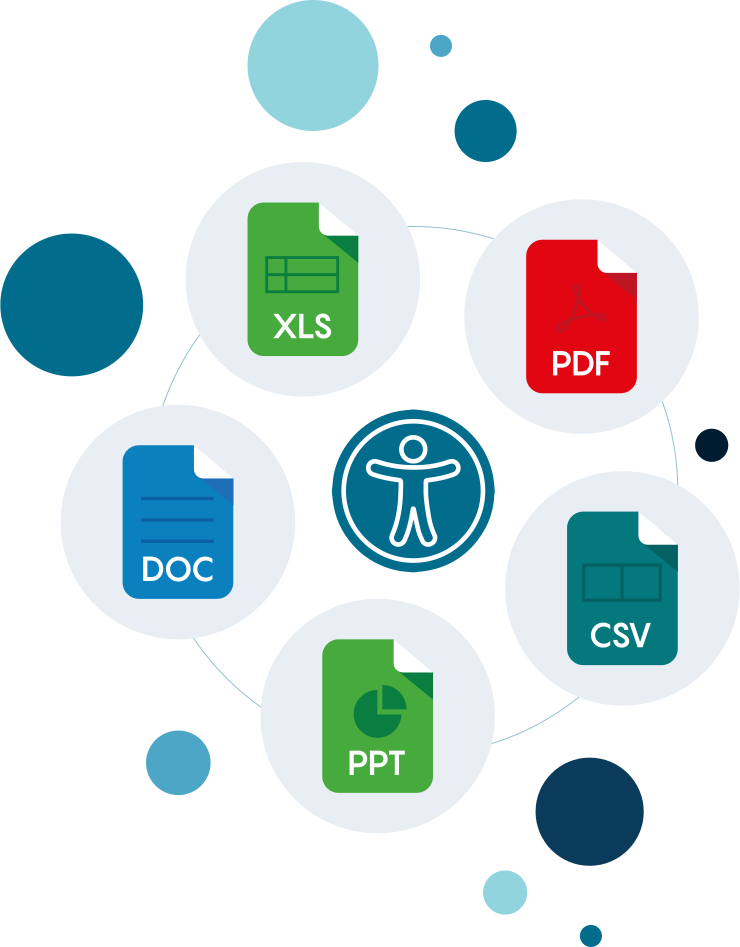
We handle a wide range of formats, including PDF, Microsoft Word, PowerPoint, and Excel. We can also remediate infographics, charts, and scanned documents to make them fully accessible.
Our documents are generated by a third-party EHR system. Can you still fix them?
Absolutely. We work with documents from any source. We can establish a workflow to receive documents generated by your EHR or other systems, remediate them, and return them for secure distribution to your patients.
What is the difference between WCAG and PDF/UA?
WCAG provides broad guidelines for all web content. PDF/UA is a specific international standard for PDF accessibility. We ensure your documents conform to both, providing the highest level of compliance and usability.